ISAPS Statistics 2025: Fewer injections, more lifting? The latest trends in cosmetic surgery
Which cosmetic surgery procedures are performed most frequently worldwide?
Which cosmetic procedures are becoming more popular – and what has changed since 2024?

The latest edition provides answers to these questions Global Survey by the International Society of Aesthetic Plastic Surgery (ISAPS). The international survey provides a comprehensive overview of surgical and non-surgical cosmetic treatments carried out worldwide in 2025.
The new figures are striking: whilst non-surgical treatments are declining significantly, the number of surgical procedures remains largely stable overall. Certain types of body contouring surgery are even seeing a substantial increase. This trend is consistent with figures from the American Society for Plastic Surgery (ASPS), which were recently published. There, the trend was attributed to weight-loss injections (GLP-1 agonists). Our American colleagues report that the majority of their patients use these medicines.
Particularly striking are the Breast lift procedures up by 48.1 per cent, eyelid surgery (+16.2 %) and brow and neck lifts. At the same time, treatments involving hyaluronic acid fell by 25.2 per cent and those involving botulinum toxin by 7.0 per cent.
Is there a shift here from repeated injection treatments towards targeted surgical lifts? Statistics alone cannot answer this question. From a specialist’s point of view, however, it is worth taking a closer look at this contrasting trend.
Trends. Around 35.2 million cosmetic procedures worldwide
For 2025, ISAPS estimates that worldwide there will be around 35.2 million cosmetic procedures and treatments of which approximately:
- 17.88 million on surgical procedures
- 17.32 million on non-surgical treatments
Compared with 2024, the total number of comparable cases fell by 8.7 per cent back. However, it is crucial to look at these two areas:
- The number of surgical procedures remained at a level that was down by only 0.4 per cent remaining virtually stable.
- Non-surgical treatments, on the other hand, fell by 15.7 per cent Back.
It is therefore less a case of a general decline in aesthetic medicine than a shift within the various forms of treatment.
The five most common cosmetic surgery procedures in 2025
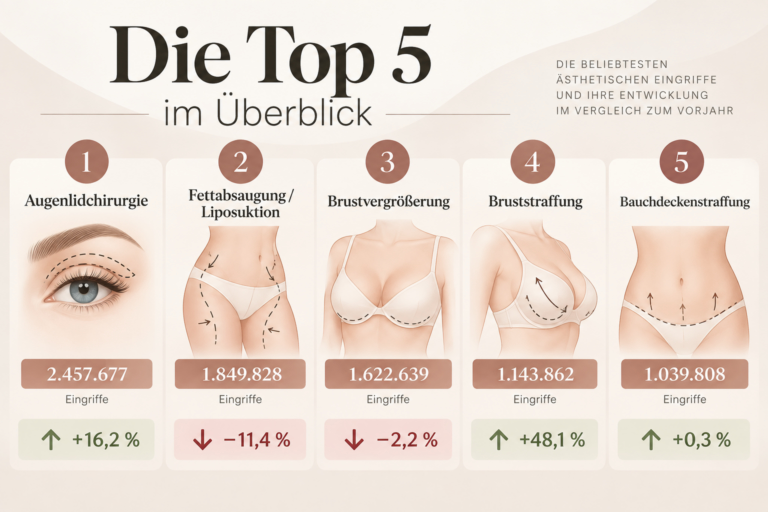
In 2025, the most commonly performed cosmetic surgery procedure worldwide will be the Eyelid surgery.
The top 5 at a glance:
- Eyelid surgery: 2,457,677 procedures (+16,2 %)
- Liposuction / Liposuction: 1,849,828 procedures (−11.4 %)
- Breast enlargement: 1,622,639 procedures (−2.2 %)
- Breast lift: 1,143,862 procedures (+48,1 %)
- Abdominoplasty: 1,039,808 procedures (+0,3 %)
These five procedures alone demonstrate just how differently individual areas of cosmetic surgery are developing.
Eyelid surgery remains number one worldwide
With around 2.46 million procedures Eyelid surgery is the most common cosmetic surgical procedure worldwide.
Compared with 2024, when around 2.12 million procedures were recorded, this represents an increase of 16.2 per cent. Compared with 2021, the increase is as much as 69.9 per cent.
Other facial tightening procedures also showed positive growth. The number of brow lifts rose by 23.5 per cent compared with 2024, whilst the number of neck lifts increased by 13.2 per cent. The Facelift remained virtually unchanged, with an increase of 0.3 per cent. Overall, the number of comparable operations in the face and head area fell by 3.2 per cent to.
The longer-term comparison is also striking: since 2021, eyelid operations have risen by 69.9 per cent, facelifts by 54.7 per cent and Neck lifts by 85.8 per cent.
Breast lift: Almost 50 per cent more procedures
One of the most striking changes in the ISAPS statistics as a whole concerns the Breast lift (mastopexy).
In 2025, there were around 1.14 million breast lifts carried out. These are 48.1 per cent more than in 2024. This means that breast lifts have risen to fourth place among the world’s most common cosmetic procedures.
The situation is different when it comes to traditional breast augmentation. The number of such procedures fell by 2.2 per cent to around 1.62 million. At the same time, the number of breast implant removals rose by 5.4 per cent to around 361,000 procedures.
Overall, comparable breast surgeries showed an increase of 5.7 per cent.

„The marked increase in breast lifts is consistent with our experience in daily practice,“ explains Prof. Dr Ernst Magnus Noah, Chief Medical Officer at the Noahklinik.
„Nowadays, many women are no longer seeking simply to increase their breast size, but rather a harmonious, natural restoration of their figure – for example, following pregnancy, breastfeeding or significant weight loss. The trend is clearly moving towards an authentic aesthetic rather than an artificial fullness.“
Liposuction remains common – but is on the decline compared with 2024
The Liposuction With around 1.85 million procedures, it continues to rank second in the global statistics.
Compared with 2024, however, their number fell by 11.4 per cent Back.
By contrast, the number of tummy tucks remained virtually unchanged at around 1.04 million procedures, representing an increase of 0.3 per cent. Overall, the number of comparable operations on the body and limbs fell by 8.9 per cent.
Here, too, it is therefore worth taking a nuanced view: not all body-contouring operations follow the same trend.
Significant decline in hyaluronic acid and botulinum toxin
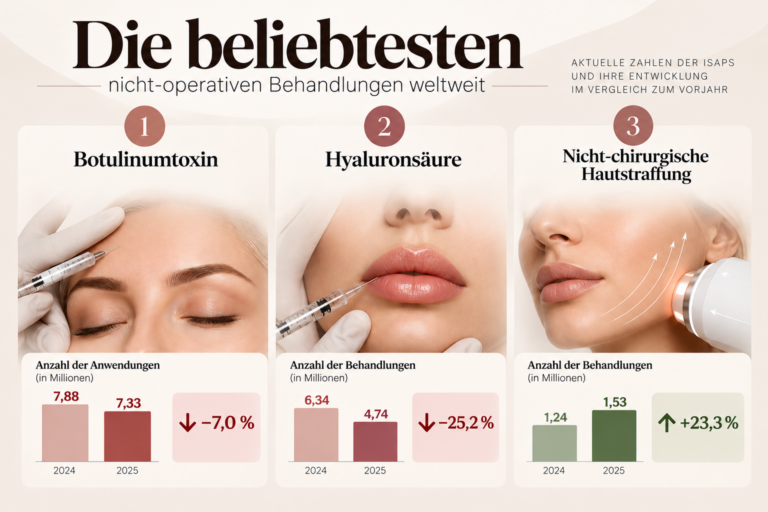
The latest statistics become particularly interesting when compared with the non-surgical treatments.
Botulinum toxin remains at around 7.33 million applications Although it is by far the most common non-surgical cosmetic treatment worldwide, the number of procedures fell by 7.0 per cent. The change is even more pronounced in the case of Hyaluronic acid . The number of treatments fell from around 6.34 million in 2024 to approximately 4.74 million in 2025 back. This represents a decrease of 25.2 per cent.
Non-surgical skin tightening is an exception. In this area, the ISAPS has recorded an increase of 23.3 per cent to around 1.53 million treatments.
Overall, the number of non-surgical procedures fell by 15.7 per cent Back.
Fewer injections, more facelifts?
If you compare the figures side by side, an interesting contrasting trend becomes apparent.
On the one hand, some of the major injection treatments are on the decline: Hyaluronic acid by 25.2 per cent and botulinum toxin by 7.0 per cent. On the other hand, various types of surgical lifting procedures are on the rise: breast lifts by 48.1 per cent, brow lifts by 23.5 per cent, eyelid surgery by 16.2 per cent and neck lifts by 13.2 per cent.
The ISAPS figures alone do not allow us to no causal link can be inferred from these trends. The statistics initially show only that both trends are occurring in parallel.
From a specialist’s point of view, however, this shift is nevertheless interesting.
„On the one hand, we are seeing a significant decline in injection treatments and, on the other, in some cases a considerable increase in skin-tightening procedures,“ explains Prof. Dr Noah. „This is consistent with a trend we are also observing in our consultations. An injection can add volume or soften certain signs of ageing. However, it cannot remove actual excess skin or tissue. Where indicated, a targeted surgical lift may therefore be the more appropriate and longer-term treatment.“
This does not in any way mean that surgical procedures are generally better than minimally invasive treatments. Both have various indications and options.
Botulinum toxin, hyaluronic acid or other non-surgical procedures can produce very good results when used in a targeted and judicious manner. However, in cases of significant excess skin or tissue, they reach their anatomical limits.
The crucial question is therefore not: An injection or an operation?
Rather: Which treatment is best suited to the actual anatomical situation and the desired outcome?
A critical look at the ISAPS figures: these are extrapolations
With a figure of 35 million treatments, one might easily get the impression that every single procedure has been recorded individually. However, that is not the case.
The ISAPS statistics are no comprehensive global survey of all plastic surgeons.
For the 2025 statistics, data was sourced from 2,900 plastic surgeons submitted or made available. The figure for the previous year was 2,975.
Of course, not all plastic surgeons in a country take part in the survey. Similarly, not all plastic surgeons worldwide are members of ISAPS. Therefore, based on the data collected, statistical projections created.
Put simply: the treatment figures provided by the participating surgeons form a sample. Based on this, and taking into account the estimated number of actively practising plastic surgeons in a country, an estimate is made of the total number of such procedures carried out there.
ISAPS itself explains that the final figures on the the estimated number of actively practising plastic surgeons in the respective countries and the sample of respondents are based on. So, for example, when it is stated that there are around 2.46 million eyelid operations worldwide, this does not mean that ISAPS has received 2.46 million individual reports of such operations. The figure is a statistical estimate based on the data collected.
Why the changes compared with 2024 are nevertheless meaningful
A certain degree of caution is also required when making year-on-year comparisons.
In 2025, 51 countries and regions listed individually, compared with 32 in the previous report. In addition, new types of treatment were included in the survey. ISAPS expressly points out that the broader data set may affect the global totals.
This is precisely why the way in which the percentage changes are calculated is important: when comparing figures with previous years, ISAPS only takes into account procedures that have been recorded consistently over the relevant periods. The figures should therefore not be understood as an exact count, but rather as a scientifically derived estimate and as an indication of international trends.
Trends are interesting – what matters is the individual indication
International statistics can highlight trends. However, they must not be used to determine whether a procedure is appropriate for an individual patient.
Whether a Eyelid lift, breast lift, tummy tuck, liposuction or a facelift Whether this is a suitable option depends on individual circumstances. These include, amongst other things, anatomy and tissue quality, general health, as well as personal preferences and realistic expectations regarding the outcome.
„In reputable cosmetic surgery, we don’t treat trends – we treat people,“ emphasises Prof. Dr Noah.
„Our role during the initial consultation often involves advising against unsuitable treatments and suggesting personalised, long-term alternatives.“
That is why treatment at the Noahklinik always begins with the personalised consultation with a specialist and an individual assessment of suitability.
Exclusively specialists in plastic and aesthetic surgery
When deciding on cosmetic surgery, the desired result should not be the only factor to consider. Of central importance is also the Qualifications of the attending doctor.
The Noahklinik provides consultations, surgical treatment and aftercare solely through Specialists in Plastic and Aesthetic Surgery.
Specialist training provides the foundation for a sound knowledge of anatomy, various surgical techniques, and the recognition and management of potential complications. In aesthetic surgery in particular, it is also important to be able to, not to automatically carry out every treatment that is technically possible. Responsible specialist medical advice also involves highlighting limitations, advising against unsuitable procedures or discussing alternative treatment options.
After all, a natural result does not begin in the operating theatre, but rather with a careful assessment of the patient’s condition.
Patient safety: The Noah Clinic as a licensed Section 30 clinic
As well as the qualifications of the treating doctors, the clinical setting plays an important role in patient safety.
The Noahklinik holds a licence as Private hospital in accordance with Section 30 of the Trade Regulation Act (GewO). The Noahklinik therefore offers a clinical infrastructure for surgical procedures that goes beyond simply carrying out an operation. Of particular importance is the ability to provide patients with care following more extensive operations to provide inpatient care and monitoring.
Particularly following procedures such as a breast lift, tummy tuck or facelift, patients are not required to leave the clinic immediately after the procedure. The initial post-operative phase can take place within the clinic.
This enables continuous medical care and a rapid response where necessary.
Of course, even a comprehensive clinical infrastructure cannot completely eliminate the general risks associated with surgery or anaesthesia. However, it does provide an important organisational and medical framework for Surgery, post-operative monitoring and aftercare.
Specialist care and hospital structure go hand in hand
From the Noahklinik’s point of view, medical qualifications and clinical infrastructure are therefore two sides of the same coin.
A responsibly planned cosmetic surgery procedure involves more than just the operation itself. It begins with a detailed consultation with a specialist and extends from careful planning and execution of the operation through to post-operative care and follow-up.
The combination of Treatment provided exclusively by specialists in plastic and aesthetic surgery and the possibilities of a a licensed Section 30 clinic provides an appropriate medical framework for this.
It should not be the current trend that determines whether a treatment is carried out. What matters is whether it makes medical sense for the individual and whether the benefits, options and risks have been carefully weighed up against one another.
Conclusion: Cosmetic surgery is changing – quality and safety remain paramount
The ISAPS Global Survey 2025 highlights an interesting development within the field of aesthetic medicine.
Overall, the number of treatments recorded fell compared with 2024. Whilst non-surgical procedures saw a significant decline, the number of surgical procedures remained virtually stable.
The trend is particularly striking in the case of various Lifting operations. Breast lifts increased by 48.1 per cent, brow lifts by 23.5 per cent, eyelid surgery by 16.2 per cent and neck lifts by 13.2 per cent. At the same time, hyaluronic acid treatments fell by 25.2 per cent and botulinum toxin treatments by 7.0 per cent.
Statistics cannot determine whether there is a direct causal link between the two trends. From a specialist’s point of view, however, this contrasting trend is noteworthy. It also highlights how important it is to distinguish between different treatment approaches: Injection treatment can be a sensible, minimally invasive option – but it cannot replace surgical tightening in cases of significant excess skin or tissue.
It is equally important to interpret the figures themselves critically. The ISAPS statistics are not a comprehensive survey, but rather a Extrapolation based on an international sample of plastic surgeons. It is therefore particularly well suited to highlighting trends and changes – not to providing an exact picture of every procedure carried out worldwide.
Ultimately, something else is crucial for patients: It is not the frequency of a treatment that makes it the right one.
At the Noahklinik, the focus is therefore on individual medical needs, honest advice and natural treatment outcomes. All consultations, treatments and follow-up care are carried out by Specialists in Plastic and Aesthetic Surgery. This commitment is complemented by the clinical infrastructure of the a licensed Section 30 clinic with the option of inpatient care following any necessary procedures.
The Noahklinik thus combines modern plastic and aesthetic surgery with specialist qualifications, personalised treatment and a high standard of patient safety.
You might also like:
How to arrange a personalised consultation
Are you interested in a Eyelid lift, breast lift, breast augmentation, tummy tuck, liposuction, a facelift or another aesthetic or cosmetic procedure?
During a personal consultation, our specialists can assess your individual circumstances, explain the various treatment options and discuss with you which course of action makes the most sense from a medical point of view.
Please feel free to book your personal consultation at the Noahklinik.